
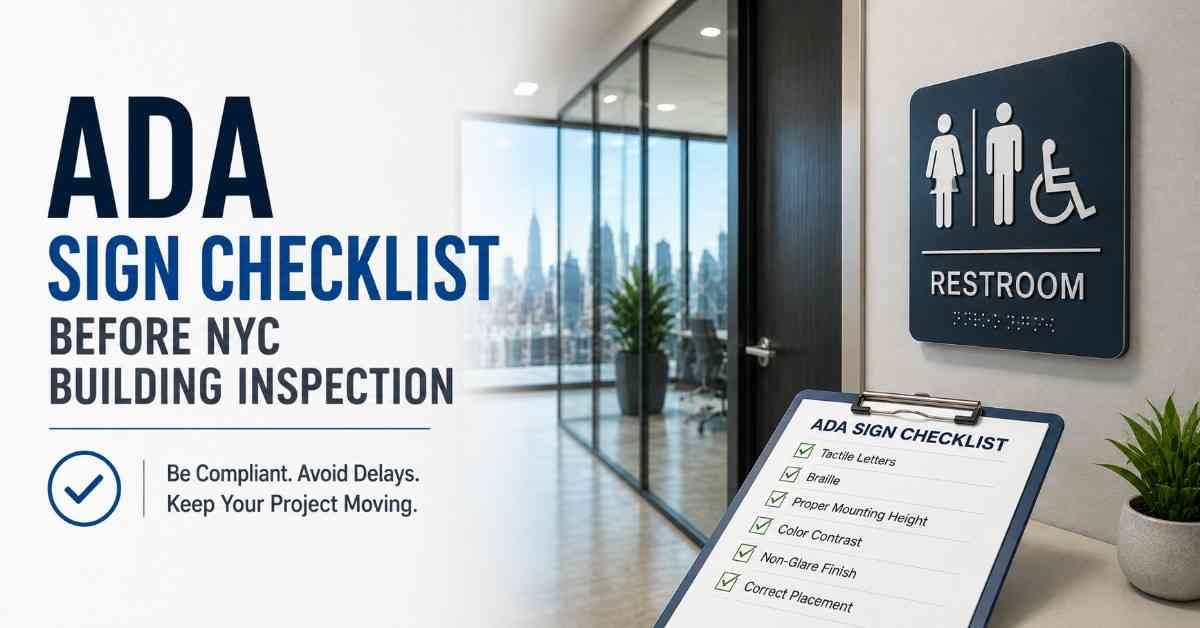

Whether you’re opening a new office, renovating a commercial property, or preparing for a New York City building inspection, ensuring your ADA compliance signs NYC meet federal and local accessibility standards is essential. Missing or improperly installed ADA signs can delay inspections, require costly replacements, and negatively impact the experience of employees and visitors.
The good news is that preparing for an inspection doesn’t have to be overwhelming. By following a clear ADA signage checklist, you can identify potential issues before inspectors do and keep your project moving forward.
This guide outlines the key items every NYC business should review before a building inspection.
Why ADA Sign Compliance Matters
The Americans with Disabilities Act (ADA) requires many commercial buildings to provide accessible signage that allows people with visual impairments to navigate independently.
Proper ADA signage helps businesses:
- Meet accessibility requirements
- Improve visitor safety
- Create an inclusive environment
- Avoid unnecessary inspection delays
- Reduce the risk of expensive corrections after installation
For offices, healthcare facilities, restaurants, educational institutions, hotels, and retail stores, ADA signage is an important part of building compliance.
ADA Sign Checklist Before Inspection
Use this checklist before your NYC building inspection.
✔ Check That All Permanent Rooms Have ADA Signs
ADA signs are generally required for permanent spaces such as:
- Restrooms
- Conference rooms
- Examination rooms
- Offices
- Stairwells
- Elevators
- Mechanical rooms
- Electrical rooms
- Exit doors
Walk through your building and confirm that every required room has compliant signage installed.
✔ Verify Raised Tactile Lettering
Permanent room identification signs should include tactile lettering.
Inspect each sign to ensure:
- Letters are raised
- Characters are easy to read
- Letter spacing is consistent
- Fonts are clear and simple
Simple sans-serif fonts typically provide the best readability.
✔ Confirm Grade 2 Braille
Braille is one of the most important ADA requirements.
Check that:
- Grade 2 contracted Braille is used
- Braille is correctly positioned beneath the tactile text
- Braille is free from damage or defects
Incorrect Braille placement or translation can lead to compliance issues.
✔ Review Color Contrast
Signs should be easy to read for individuals with low vision.
Good examples include:
- White text on black
- Black text on white
- Dark gray on light gray
- Navy blue on white
Avoid low-contrast color combinations that reduce visibility.
✔ Ensure a Non-Glare Finish
Highly reflective signs can become difficult to read under office lighting.
Verify that ADA signs feature:
- Matte finishes
- Satin finishes
- Non-glare materials
This improves readability in hallways, lobbies, and common areas.
✔ Check Mounting Height
Improper installation is one of the most common reasons signs fail inspection.
ADA signs are generally installed:
- Between 48 and 60 inches from the finished floor
- On the latch side of the door whenever possible
Consistent placement helps users locate signs easily throughout the building.
✔ Review Pictograms
Where required, pictograms should be:
- Large and easy to identify
- Consistently designed
- Paired with tactile text
- Accompanied by Grade 2 Braille when applicable
Common pictograms include:
- Restrooms
- Accessible entrances
- Elevators
- Stairways
✔ Inspect Sign Condition
Damaged signs can create a poor impression and may require replacement.
Look for:
- Scratches
- Loose mounting
- Peeling finishes
- Broken Braille
- Faded colors
- Cracked acrylic
Replacing worn signage before inspection demonstrates professionalism and attention to detail.
✔ Verify Directional and Wayfinding Signs
Although not every directional sign requires ADA features, your building should provide clear navigation.
Review signage for:
- Reception
- Departments
- Waiting areas
- Elevators
- Emergency exits
- Accessible routes
Clear wayfinding improves the visitor experience and supports overall accessibility.
✔ Maintain Consistent Branding
ADA compliance doesn’t mean sacrificing your company’s identity.
Professional ADA signs can still incorporate:
- Brand colors (while maintaining contrast)
- Consistent typography
- Matching materials
- Cohesive interior design
Many NYC businesses successfully combine compliance with modern branding.
Common ADA Sign Compliance Mistakes
Businesses often overlook small details that can delay inspections.
Examples include:
- Missing Braille
- Incorrect mounting height
- Poor color contrast
- Glossy sign finishes
- Missing room identification signs
- Incorrect tactile lettering
- Damaged or outdated signage
Avoiding these mistakes before an inspection can save both time and money.
Related Reading: ➡️ Common ADA Sign Compliance Mistakes Businesses Make
Choosing the Right ADA Sign Material
Selecting the right material affects both durability and appearance.
Popular options include:
Acrylic ADA Signs
- Modern appearance
- Lightweight
- Available in custom colors
- Ideal for offices and corporate interiors
Metal ADA Signs
- Premium finish
- Highly durable
- Excellent for hospitals, universities, and commercial buildings
Learn more here: ➡️ Metal vs Acrylic ADA Signs
How Much Do ADA Signs Cost?
The overall investment depends on:
- Number of signs
- Material selection
- Custom branding
- Braille requirements
- Installation needs
For a detailed pricing guide, read: ➡️ ADA Sign Costs in NYC
ADA Sign Checklist for Restaurants & Hospitality
Restaurants, hotels, cafés, and hospitality businesses often require additional accessible signage for public spaces.
If you operate within the hospitality industry, this guide may help: ➡️ ADA Signs for NYC Restaurants and Hospitality
Why Work with Custom Signs NY?
Preparing for a building inspection is much easier when you work with experienced professionals.
At Custom Signs NY, we help businesses across New York City design, fabricate, and install ADA-compliant signage that meets accessibility standards while complementing your interior branding. Our team can assist with everything from room identification signs and Braille signage to complete ADA signage systems for offices, healthcare facilities, restaurants, schools, and commercial buildings.
👉 Request a Quote today to ensure your business is inspection-ready with professionally designed ADA signage.
Frequently Asked Questions
Are ADA signs required before a building inspection?
Yes. Permanent room identification signs should generally be installed before the final inspection to demonstrate accessibility compliance.
What rooms usually require ADA signs?
Common examples include restrooms, conference rooms, offices, elevators, stairwells, mechanical rooms, electrical rooms, and other permanent spaces.
What is the correct mounting height for ADA signs?
ADA room identification signs are typically mounted between 48 and 60 inches above the finished floor on the latch side of the door.
Can branded ADA signs still be compliant?
Yes. Businesses can incorporate their branding while maintaining proper contrast, tactile lettering, Braille, and other ADA requirements.
How often should ADA signs be inspected?
It’s a good practice to review ADA signage during renovations, office expansions, rebranding projects, or before scheduled building inspections to ensure signs remain compliant and in good condition.