
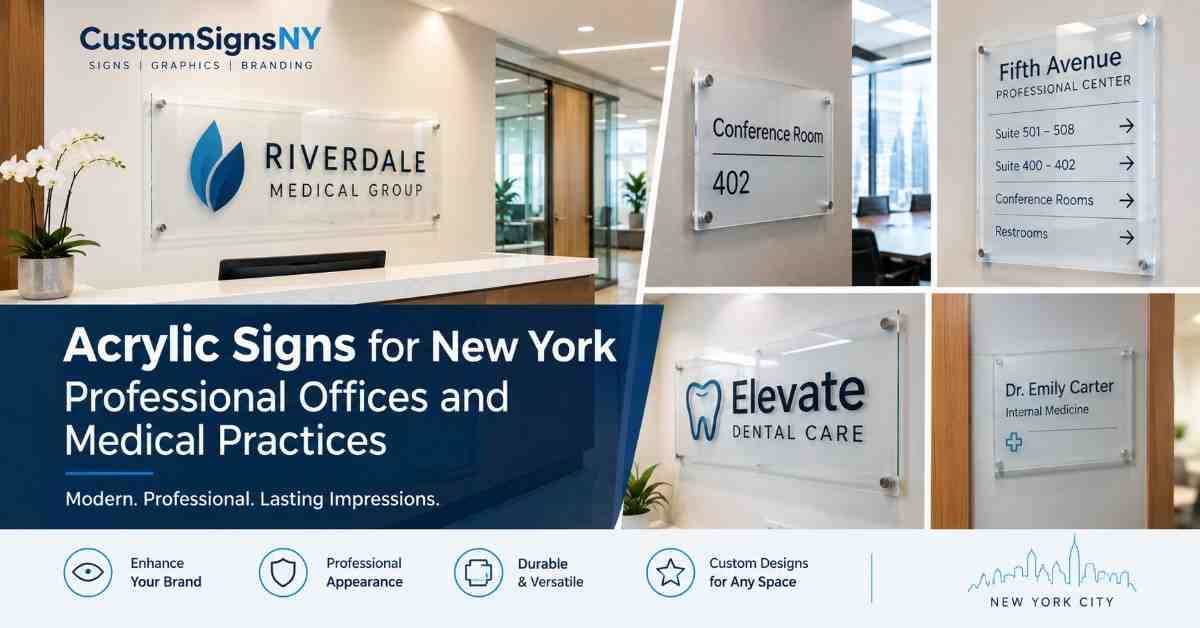

First impressions matter in professional environments. Whether a client enters a Manhattan law office, a corporate headquarters, or a medical practice in New York City, the signage helps shape how they perceive the business before their appointment even begins.
Acrylic signs for professional offices and medical practices offer a clean, contemporary way to display business names, logos, room numbers, and important visitor information. Their smooth surfaces, versatile finishes, and customization options make them suitable for a wide range of commercial interiors.
From branded reception signs to office door plaques and clinic directories, acrylic signage can help businesses create a consistent and professional environment.
In this guide, we explore the benefits of acrylic signs, popular design options, applications for offices and healthcare facilities, and factors to consider when planning a custom signage project in NYC.
What Are Acrylic Signs?
Acrylic signs are made from a durable plastic material commonly used as an alternative to glass for many signage applications. Acrylic can be cut, printed, engraved, layered, or fabricated into different shapes and sizes.
Depending on the design, acrylic signs can have a transparent, frosted, colored, glossy, or matte appearance. They can also be combined with dimensional lettering, printed graphics, and other materials to create customized branding displays.
Common types of acrylic signage include:
- Acrylic logo signs: Display a company’s logo in reception areas and client-facing spaces.
- Dimensional acrylic letters: Raised letters mounted individually or arranged as part of a logo.
- Acrylic office door signs: Identify offices, conference rooms, and departments.
- Acrylic directory signs: Help visitors locate professionals, departments, or suites.
- Frosted acrylic signs: Provide a softer, understated appearance for professional interiors.
- Layered acrylic signs: Combine colors, thicknesses, or backing layers for a dimensional effect.
- Printed acrylic panels: Display company branding, room information, or other graphics.
The right option depends on the location, design requirements, available mounting surface, and the type of information the sign needs to communicate.
Why Choose Acrylic Signs for NYC Offices?
Professional offices often need signage that balances appearance, readability, and practical functionality. Acrylic offers several advantages that make it worth considering.
1. A Clean and Professional Appearance
Acrylic signage can complement modern office interiors without overwhelming the space. Its smooth finish works well with glass partitions, painted walls, reception desks, and contemporary furniture.
A corporate office might use a clear acrylic panel with a minimalist logo, while a consulting firm could choose colored acrylic letters that match its brand identity.
For professional environments where presentation matters, the sign’s proportions, contrast, finish, and placement can be just as important as the material itself.
2. Flexible Branding and Customization
Acrylic can be customized to reflect a company’s visual identity. Businesses can select logo colors, letter styles, panel shapes, finishes, and mounting methods to suit their interiors.
Customization options may include:
- Printed company logos
- Raised lettering
- Transparent or colored panels
- Matte and glossy finishes
- Layered designs
- Contrasting backgrounds
- Wall-mounted or stand-off installations
These options allow a business to maintain consistent branding from the reception area to individual offices and meeting rooms.
3. A Lightweight Alternative to Glass
Acrylic is generally lighter than glass of comparable dimensions, which can make it a practical option for many interior sign installations.
Its suitability still depends on the sign’s size, thickness, mounting method, and installation conditions. Larger panels or signs installed in high-traffic areas should be specified and mounted appropriately.
4. Suitable for Different Office Environments
Acrylic signs can be used in a variety of professional settings, including:
- Law firms and legal offices
- Accounting and financial services firms
- Consulting companies
- Corporate headquarters
- Real estate offices
- Medical and dental practices
- Therapy and wellness clinics
- Shared offices and coworking spaces
Because the material is versatile, a single signage project can include branded reception displays, office identification signs, and supporting information panels.
5. Easy-to-Maintain Surfaces
Acrylic signs can generally be maintained with a soft microfiber cloth and a cleaner approved for acrylic surfaces. Avoid abrasive pads and harsh solvents that may scratch, cloud, or damage the material. Follow the fabricator’s cleaning instructions, especially for printed, coated, or layered signs.
For medical practices and other environments with specific cleaning protocols, confirm that the selected sign materials and finishes are compatible with the facility’s cleaning products.
Best Acrylic Sign Ideas for Professional Offices
Different areas of a professional office have different signage needs. A reception logo creates a brand impression, while a room sign helps visitors navigate the space.
1. Acrylic Reception Logo Signs
The reception area is often the first place clients, visitors, and business partners encounter a company. An acrylic logo sign mounted behind the reception desk can make the company name more prominent and create a consistent focal point for the interior.
Popular design options include clear acrylic panels, colored logo elements, dimensional acrylic lettering, and layered designs. For a minimalist office, a transparent panel with a carefully positioned logo may work well. A company seeking stronger contrast could choose colored acrylic or raised lettering against a complementary wall.
2. Acrylic Office Door Signs
Door signs help visitors identify individual offices and understand where appointments or meetings take place.
They can display:
- Employee or professional names
- Job titles
- Department names
- Office numbers
- Meeting room names
- General room identification
Keep text readable and layouts consistent throughout the building. If room assignments change frequently, consider a design that allows information to be updated without replacing the entire sign.
3. Acrylic Directory Signs
Large offices, multi-tenant buildings, and professional suites may need directories to guide visitors. Acrylic directory panels can display company names, suite numbers, departments, or professional listings. Depending on the design, printed inserts or replaceable components may make future updates easier.
Plan the layout around the number of listings, expected changes, viewing distance, and available wall space.
4. Acrylic Conference Room Signs
Conference room signage can combine a professional appearance with straightforward identification. A sign might display a room name, company branding, or a room number. Offices that use room-booking systems may also require separate scheduling displays or replaceable room-status indicators.
Consistent typography, spacing, and mounting height can help create a unified look across meeting rooms.
5. Acrylic Suite and Building Identification Signs
Professional offices located in multi-tenant buildings may need signs that identify a suite or business entrance. Acrylic panels can display a company name, logo, or suite number. Before installation, confirm the building’s signage guidelines, approved locations, and any restrictions imposed by the property manager.
For signs visible from common corridors or public areas, consider the viewing distance and how the sign fits into the building’s existing signage system.
Acrylic Signs for Medical and Dental Practices
Medical practices have additional considerations because signage needs to support patient navigation, privacy, and a calm, organized environment.
Acrylic can be used for many interior identification and branding applications, provided the selected material and design meet the facility’s practical requirements.
1. Medical Reception and Practice Logo Signs
A branded reception sign can help patients recognize the practice when they enter. Medical offices may choose a simple logo panel with clear typography and restrained colors. Dental offices, specialist clinics, and wellness practices can customize the design to suit their identity while maintaining a welcoming atmosphere.
Avoid overcrowding the sign with excessive text. The practice name and logo should remain easy to identify.
2. Doctor Name and Specialty Signs
Office door signs can identify physicians, dentists, therapists, and other healthcare professionals. Depending on the practice, signs may display the professional’s name, title, specialty, or room number. A consistent layout helps patients understand where they need to go.
If staff names or room assignments change regularly, consider a system with replaceable information panels.
3. Patient Direction and Room Identification
Medical facilities often need signs for consultation rooms, examination rooms, reception areas, waiting rooms, and administrative spaces. Acrylic can be used for room identification and directional signs, but the design should prioritize readability and clear wayfinding.
Where accessibility requirements apply, a standard decorative acrylic sign may not be sufficient. Certain room identification signs may require tactile characters, Braille, specific contrast, or compliant mounting and placement. Assess the applicable requirements for the facility and location before finalizing the signage.
4. Privacy and Confidentiality Considerations
Medical practices should ensure that signage communicates necessary information without unnecessarily exposing confidential patient details. For example, public-facing room signs can identify a room number or general department rather than displaying patient names or appointment information.
Acrylic signage itself does not guarantee privacy. Consider the information displayed, where the sign can be viewed, and the practice’s privacy procedures.
5. Consistent Signage Across the Facility
A medical practice may need several sign types, including reception logos, room signs, directories, and directional panels. Using a consistent design system helps visitors navigate the facility and makes the practice feel more organized.
Consider standardizing colors, fonts, panel shapes, logo placement, and room-number styles across the entire facility rather than ordering signs individually without an overall plan.
Acrylic Signs vs. Metal Signs: Which Is Better?
Acrylic and metal are both useful materials for professional signage, but they create different visual effects.
| Feature | Acrylic Signs | Metal Signs |
|---|---|---|
| Appearance | Contemporary, smooth, and versatile | Refined, substantial, and architectural |
| Design options | Clear, colored, printed, frosted, and layered | Brushed, polished, coated, or other metal finishes |
| Visual effect | Can appear lightweight or dimensional | Can create a solid, premium impression |
| Common applications | Reception logos, office doors, directories, clinic interiors | Corporate branding, premium reception displays, building identification |
| Customization | Printing, cutting, layering, and dimensional letters | Fabricated letters, cut shapes, and selected finishes |
| Maintenance | Requires acrylic-compatible cleaning methods | Depends on the metal, finish, and environment |
Neither material is universally better. Acrylic may suit an office that needs a clean, contemporary appearance, while metal may be preferable when the desired finish calls for a more substantial look.
Some projects can combine the two materials—for example, metal letters mounted on an acrylic panel.
Acrylic Signs vs. Glass Signs
Acrylic is sometimes selected as an alternative to glass for interior signage because it is generally lighter and can be fabricated in a range of colors and shapes. Glass signage may offer a distinctive appearance and suit certain high-end interiors, but the material, weight, edge treatment, mounting system, and breakage considerations need to be evaluated.
When comparing the two, consider the sign’s dimensions, installation location, desired transparency, maintenance, and the level of physical contact expected.
The best choice depends on the complete installation rather than appearance alone.
How to Choose the Right Acrylic Sign for Your Business
Before ordering acrylic signage, evaluate the following factors.
1. Define the Purpose: Determine whether the sign will display a company logo, identify an office, direct visitors, or provide important room information. A reception logo may prioritize visual impact, while a directional sign needs to communicate information quickly.
2. Select the Right Size: The sign should be proportionate to its location and readable from the expected viewing distance. A small door plaque may work well for individual office identification, while a reception logo may require larger lettering to remain visible across the room.
3. Choose a Suitable Finish: Consider whether clear, frosted, colored, matte, or glossy acrylic best complements the interior. The background and lighting also influence the appearance of the finished sign. Ask to review a sample or mockup when the color, finish, or mounting method is important to the design.
4. Review Lettering and Contrast: A beautiful sign is not effective if visitors cannot read it. Choose a legible typeface, suitable character sizes, and sufficient contrast between the text and background. Keep decorative elements from interfering with the main message.
5. Plan the Mounting Method: Acrylic signs may be mounted directly to a wall, attached with suitable hardware, or installed using stand-offs to create separation from the surface. The mounting method should account for the sign’s dimensions, weight, substrate, and installation environment. Check the wall surface and any property restrictions before fabrication.
6. Consider Accessibility: For offices and healthcare facilities, assess whether any signs are subject to accessibility requirements. Some room identification and permanent-space signs may need tactile information, Braille, specific contrast, or particular placement. Decorative acrylic signage should not automatically be treated as a substitute for required accessible signage.
7. Plan for Future Changes: If your business expects changes to employee names, departments, or room assignments, consider whether the sign can accommodate updated information. A replaceable insert or modular directory may reduce the need to replace an entire sign whenever a listing changes.
What Affects the Cost of Custom Acrylic Signs in NYC?
The cost of acrylic signage varies according to the design and installation requirements. A small, simple office plaque is a different project from a large reception logo with multiple layers and custom mounting hardware.
Important cost factors include:
- Dimensions: Larger signs generally require more material.
- Thickness: Acrylic thickness affects the sign’s appearance, fabrication, and structural requirements.
- Design complexity: Custom shapes, detailed logos, and multiple layers may require additional production work.
- Printing and finishes: Colored panels, printed graphics, special finishes, and layered elements affect the specification.
- Dimensional lettering: Individual raised letters involve different fabrication and installation requirements than a flat panel.
- Mounting method: Stand-offs, concealed hardware, and installation conditions can influence the total project cost.
- Quantity: A coordinated order for multiple rooms may have different per-sign costs from a single custom sign.
- Installation access: Wall conditions, site access, and building rules can affect installation planning.
For an accurate estimate, provide the sign’s approximate dimensions, artwork or logo, intended location, preferred finish, quantity, and mounting requirements.
Common Mistakes to Avoid When Ordering Acrylic Signs
Even a high-quality material can produce a disappointing result if the sign is not planned properly.
- Choosing appearance over readability: Make sure the lettering and contrast suit the viewing distance and environment.
- Using an unsuitable cleaner: Some solvents and abrasive products can damage acrylic surfaces. Follow the manufacturer’s maintenance recommendations.
- Ignoring accessibility needs: Determine whether room identification or other signs must comply with applicable accessibility requirements.
- Ordering signs without a consistent system: Different colors, fonts, and layouts can make a multi-room office or clinic feel disorganized.
- Overlooking installation conditions: Check the mounting surface, hardware, building rules, and access before fabrication.
- Failing to plan for future updates: For directories and changing office assignments, consider replaceable information components.
Planning these details early can help create signage that looks professional and functions effectively over time.
Create a Professional Environment with Custom Acrylic Signs
The right signage helps visitors recognize your business, navigate your space, and experience a consistent brand identity. For New York professional offices and medical practices, acrylic signs offer a versatile option for reception logos, office identification, directories, and other interior applications. The best results come from balancing design, readability, materials, mounting, and the specific needs of the environment.
Whether you are furnishing a new office, renovating a medical practice, or updating an existing reception area, a coordinated signage plan can help bring the space together. Looking for custom acrylic signs in NYC? Contact CustomSignsNY to discuss your office or medical practice signage requirements and request a project estimate.