
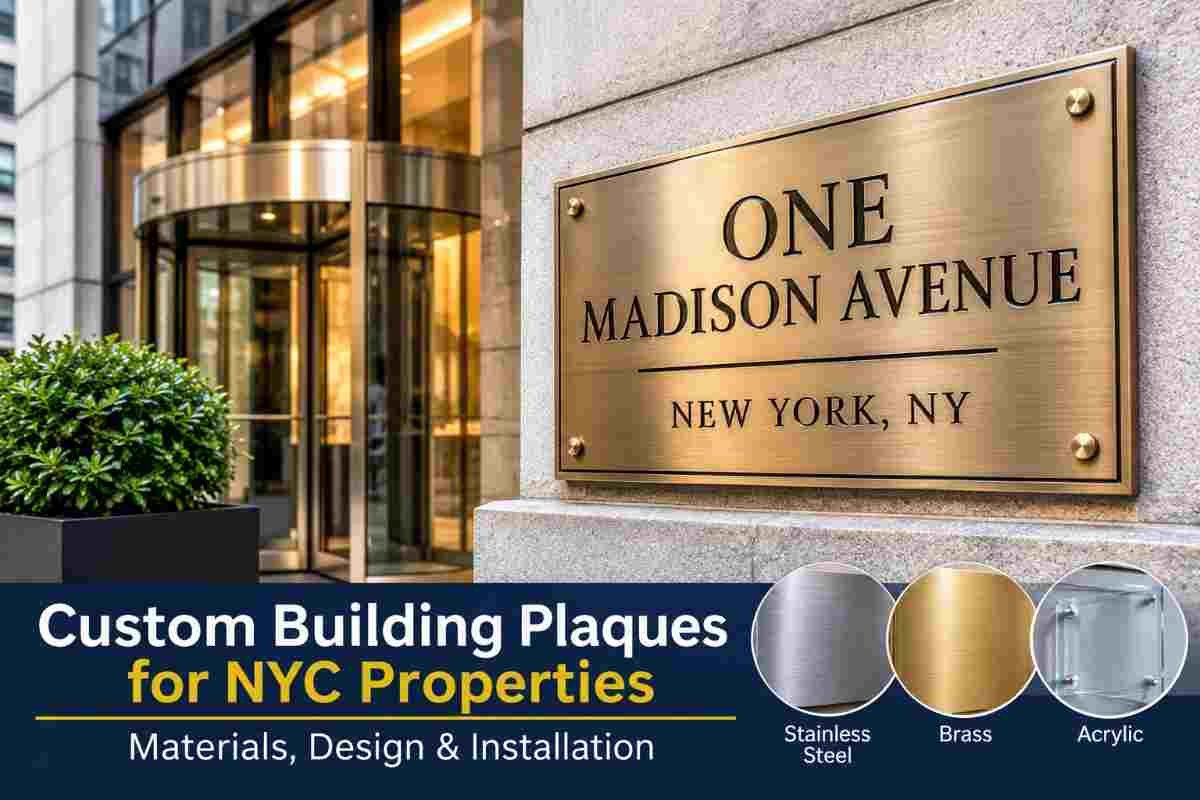

A building’s entrance is often the first point of contact for visitors, tenants, customers, and business partners. Before anyone steps inside, exterior signage helps them identify the property, understand where they are, and form an impression of the building.
Custom building plaques provide a professional way to display property names, building numbers, company identification, historical information, and other important details. From corporate offices in Manhattan to commercial properties in Brooklyn, a well-designed plaque can improve visibility while complementing the architecture.
However, choosing the right building plaque involves more than selecting a design. Material, finish, lettering, size, mounting method, and exposure to New York City’s weather all influence the finished result.
This guide explains the different types of custom building plaques, the materials available, design considerations, and what NYC property owners should consider before ordering.
1. What Are Custom Building Plaques?
Custom building plaques are permanent or semi-permanent signs installed on or near a building to communicate identification and property information.
They can be mounted beside an entrance, on an exterior wall, near a lobby, or in another location where visitors need to identify the property.
Unlike temporary signs, building plaques are typically designed to complement the property’s architecture and remain in place for an extended period.
Common information displayed on building plaques includes:
- Building or property name
- Street number and address
- Company or organization name
- Property ownership or management information
- Building dedication details
- Historical information
- Professional office or commercial suite identification
Building plaques can be manufactured in metal, acrylic, and other suitable materials, with different engraving, printing, and dimensional lettering options.
2. Where Are Building Plaques Used?
The right plaque depends on the type of property and the information visitors need to find.
Commercial office buildings
Corporate buildings often use exterior plaques to display the property name, address, or primary tenant identification. A professionally designed plaque can make an entrance easier to recognize while supporting the building’s overall appearance.
For modern office properties, brushed stainless steel, aluminum, and dimensional lettering can complement glass, stone, and metal façades.
Residential apartment buildings
Residential properties may use plaques to display building names, street numbers, or property identification. The design should be easy to read and appropriate for the architecture.
Medical and professional buildings
Medical centers, law offices, financial institutions, and professional buildings often require clear identification near their entrances.
A custom plaque can display the building name, organization, or relevant identification details while maintaining a polished appearance.
Retail and mixed-use properties
Mixed-use buildings may contain retail spaces, offices, restaurants, and residential units. Building plaques can help establish the property’s identity, while additional signs can guide visitors to individual businesses.
For storefront and retail identification, explore custom storefront and retail signs in NYC.
Historic and institutional properties
Historic buildings, educational institutions, and cultural properties may use plaques to communicate their names, founding dates, dedication information, or historical significance.
These signs often require a more traditional appearance, making engraved brass or bronze-style finishes worth considering.
3. Best Materials for Custom Building Plaques
Material selection affects the appearance, durability, maintenance, and suitability of a plaque for its installation location.
Stainless steel plaques
Stainless steel is a popular choice for contemporary commercial properties. It offers a clean, professional appearance and is available in brushed, satin, and polished finishes.
Benefits include:
- Modern architectural appearance
- Good corrosion resistance with an appropriate grade
- Suitable for many commercial applications
- Compatibility with engraved or raised lettering
- Options for understated or reflective finishes
Brushed stainless steel can work particularly well on stone, concrete, and contemporary building façades.
Brass plaques
Brass provides a classic appearance associated with established institutions, professional offices, and traditional architecture.
It can be used for building names, dedication plaques, and property identification.
Benefits include:
- Traditional and prestigious appearance
- Engraving and detailed lettering options
- Warm metallic finish
- Suitable for formal and heritage-inspired designs
The selected brass finish and protective treatment should be considered carefully for exterior exposure.
Aluminum plaques
Aluminum is lightweight and versatile. It can be fabricated in different sizes and finishes and is often considered for commercial identification and property signage.
Benefits include:
- Lightweight construction
- Flexible fabrication options
- Suitable for a variety of sign designs
- Available in different finishes and colors
The coating or finish should be selected according to the expected outdoor conditions.
Acrylic plaques
Acrylic can provide a clean, contemporary appearance and is available in clear, frosted, and colored options.
It is commonly used for interior building identification, lobby plaques, and covered locations. For exposed exterior installations, the specific acrylic grade and environmental conditions need to be evaluated.
Benefits include:
- Modern appearance
- Custom color options
- Lightweight construction
- Engraving and printing possibilities
- Layered and dimensional design options
Choosing the right material
| Material | Appearance | Common applications |
|---|---|---|
| Stainless steel | Modern and professional | Commercial buildings and office entrances |
| Brass | Traditional and prestigious | Professional properties and dedication plaques |
| Aluminum | Versatile and lightweight | Commercial property identification |
| Acrylic | Contemporary and clean | Interior plaques and suitable covered locations |
The best material depends on the building’s architecture, installation location, maintenance expectations, and desired appearance.
4. Building Plaque Design Ideas
A building plaque should be easy to read while complementing the surrounding architecture. Its design should communicate essential information without making the entrance look cluttered.
Minimalist building name plaques
A simple plaque featuring the building name and a clean typeface can create a professional appearance.
This approach works particularly well for modern office buildings, commercial properties, and mixed-use developments.
Engraved metal plaques
Engraved lettering provides a permanent, refined appearance. Brushed stainless steel and brass finishes can be used to create traditional or contemporary building identification.
Raised lettering and dimensional logos
Raised lettering adds depth and visual presence. It can be used to display a property name, organization logo, or other important information.
For projects that require dimensional branding, explore custom 3D letters and logos.
Building address plaques
A dedicated address plaque helps visitors identify the property from the entrance or sidewalk. Letter size, contrast, and placement should be considered to support readability.
Historical and dedication plaques
These plaques may include a building’s original name, construction date, architect, dedication message, or other historical details.
A traditional metal finish and carefully arranged typography can help communicate the significance of the information.
5. How to Choose the Right Size and Placement
Even a high-quality plaque can be ineffective if it is too small, poorly positioned, or difficult to read.
Before fabrication, consider the following factors.
Viewing distance
Think about how far away visitors will be when they need to read the plaque.
A sign positioned near a sidewalk may need larger lettering than one installed beside an entrance door. The building name and essential information should be readable from the expected viewing distance.
Entrance location
Common placement options include:
- Beside the main entrance
- On a wall near the building’s front door
- On an exterior stone or masonry surface
- Near a lobby entrance
- At a designated property identification area
The plaque should be placed where visitors can naturally see it without obstructing entrances, architectural features, or other required signs.
Background contrast
The plaque’s finish and lettering should contrast sufficiently with the wall surface.
For example, dark lettering on a light metal background may be suitable for some installations, while a brushed metal plaque may require darker engraved details for readability.
Information hierarchy
The building name should generally receive the most visual emphasis. Address details, secondary information, and other text should be arranged in a clear order.
Avoid overcrowding the plaque with unnecessary information.
6. Engraving, Printing, and Raised Lettering Options
The production method affects the plaque’s appearance and how information is displayed.
Engraving
Engraving creates lettering or graphics within the plaque surface. It is a common option for metal building plaques and can produce a refined, permanent appearance.
It is particularly suitable for building names, addresses, dedication messages, and formal identification.
Etching
Etching creates details through a controlled surface-treatment process. It can be used for text, logos, and decorative elements, depending on the material and production method.
Printed graphics
Printing allows businesses to incorporate logos, colors, and more detailed artwork. It can be suitable for acrylic and certain coated metal surfaces.
The printing process and protective finish should be selected according to the installation environment.
Raised lettering
Raised lettering adds a three-dimensional effect to the plaque. It can make a building name or logo more prominent and create a premium appearance.
The lettering may be manufactured separately and mounted onto a plaque or incorporated into a layered design.
7. Exterior Building Plaques and NYC Weather
New York City’s weather can affect exterior signage over time. Rain, humidity, temperature changes, sunlight, and winter conditions should all be considered when choosing materials and finishes.
A plaque installed on an exposed exterior wall may experience different conditions from one positioned under a covered entrance.
Rain and moisture
Moisture exposure can affect certain metals, finishes, fasteners, and mounting systems. Selecting an appropriate material grade and suitable hardware helps support long-term performance.
Sunlight and UV exposure
Direct sunlight can affect some finishes, printed graphics, and plastics. Material selection should account for the amount of sunlight the plaque receives.
Temperature changes
Seasonal temperature changes can influence materials and mounting components. The design and installation should account for the location and the materials being combined.
Winter conditions
Snow, ice, and de-icing products may affect exterior surfaces and hardware. Consider the plaque’s location and how it will be cleaned and maintained.
For more information, read our guide on how NYC weather affects exterior sign materials.
8. Building Plaques vs. Other Exterior Signs
Building plaques are designed primarily for property identification and information. Other exterior signs may serve different purposes, such as attracting attention, displaying a business name, or communicating services.
| Sign type | Main purpose | Typical application |
|---|---|---|
| Building plaque | Identify a property or building | Main entrance or exterior wall |
| Channel letters | Display a business name prominently | Storefronts and commercial façades |
| 3D letters | Create dimensional branding | Building façades and reception areas |
| Illuminated signs | Improve visibility in low-light conditions | Commercial entrances and storefronts |
| Address plaque | Display the property address | Building entrance or exterior wall |
A building plaque may be sufficient for a property that needs understated identification. A commercial building with multiple tenants may require additional signage to help visitors locate individual businesses.
Explore our exterior signage options in NYC if your project requires more than a building identification plaque.
9. What Affects the Cost of Custom Building Plaques?
The price of a custom building plaque depends on its specifications and installation requirements. There is no single price that applies to every property.
Important cost factors include:
- Plaque dimensions: Larger signs generally require more material and fabrication work.
- Material selection: Stainless steel, brass, aluminum, and acrylic have different material and production costs.
- Thickness: Material thickness affects weight, appearance, and fabrication requirements.
- Design complexity: Custom logos, detailed artwork, and unusual shapes may require additional production work.
- Lettering method: Engraving, printing, etching, and raised lettering have different costs.
- Finish: Specialty finishes and protective treatments may affect the final price.
- Mounting hardware: Standoffs, concealed fasteners, and other mounting systems can add to the project.
- Installation conditions: Wall material, access, mounting height, and site requirements may influence installation costs.
To receive a useful estimate, prepare the approximate plaque dimensions, artwork, preferred material, wording, and installation location.
10. Installation Considerations for NYC Properties
A building plaque needs to be securely installed and positioned appropriately for its location.
The installation method depends on the plaque’s size, weight, material, wall surface, and mounting hardware.
Wall surface
Brick, stone, concrete, glass, and metal façades require different installation considerations. The mounting method should be appropriate for the surface and should not compromise the plaque’s stability.
Mounting hardware
Common mounting approaches include direct fastening, visible standoffs, concealed hardware, and project-specific mounting systems.
The selected hardware should be suitable for the plaque material and installation environment.
Building management approval
Commercial and residential properties may have rules governing exterior modifications, signage dimensions, approved locations, and installation methods.
Before proceeding, confirm the relevant requirements with the property owner, landlord, building manager, or applicable authority.
Permits and local requirements
Some exterior signage projects may require permits or additional approvals depending on the sign type, location, building classification, and applicable NYC regulations.
Do not assume that a plaque is automatically exempt from every signage or building requirement. Confirm the rules that apply to the specific property and proposed installation.
11. Common Mistakes to Avoid When Ordering Building Plaques
A building plaque should be planned carefully before it goes into production. Avoid these common mistakes:
- Choosing a material without considering exposure: Exterior conditions should influence material and finish selection.
- Making the lettering too small: The building name and essential information should be readable from the intended viewing distance.
- Using insufficient contrast: Text should stand out clearly from the plaque background.
- Overloading the design: Too much information can make the plaque difficult to read.
- Ignoring the building’s architecture: The design should complement the property’s exterior.
- Selecting unsuitable mounting hardware: Hardware should be appropriate for the plaque weight and wall surface.
- Skipping building approval: Confirm property rules and applicable requirements before installation.
- Not reviewing final artwork: Check spelling, dimensions, logo proportions, and layout before approving fabrication.
12. How to Order a Custom Building Plaque
A clear project brief helps ensure that the final plaque meets the property’s identification and design requirements.
Before requesting a quote, prepare the following:
1. Building information: Provide the building name, address, and exact wording required on the plaque.
2. Installation location: Share whether the plaque will be installed outdoors, inside a lobby, or in a covered entrance area.
3. Approximate dimensions: Provide the desired width and height, or the available wall space.
4. Preferred material: Indicate whether you are considering stainless steel, brass, aluminum, acrylic, or another suitable option.
5. Artwork and branding: Share the company logo, building identity, or reference design.
6. Finish preference: Mention whether you prefer brushed, polished, engraved, printed, or dimensional details.
7. Installation details: Include photographs of the wall or entrance where the plaque will be installed.
These details help determine the appropriate material, design, fabrication method, and installation approach.
13. Custom Building Plaques for Commercial Properties in NYC
A building plaque is a small but important part of a property’s visual identity. It helps visitors recognize the building, supports a professional entrance, and can complement the architecture when designed with the right materials and finishes.
Whether you manage a commercial office building, professional property, residential development, or mixed-use space, the plaque should be designed around its location and intended purpose.
CustomSignsNY provides custom signage solutions for commercial properties and professional environments. Explore our custom plaques to learn more about available plaque options.
For larger building identification projects, you can also review our exterior signage solutions.
Frequently Asked Questions
1. What material is best for an exterior building plaque?
Stainless steel, aluminum, and appropriately finished brass are common options to consider. The best choice depends on the exposure conditions, desired appearance, maintenance requirements, and installation details.
2. Can building plaques be customized with a company logo?
Yes. Building plaques can incorporate company logos, property names, addresses, and other custom graphics through engraving, printing, etching, or raised lettering.
3. Are metal plaques suitable for commercial building entrances?
Yes. Metal plaques are frequently used for commercial building identification because they offer a professional appearance and can be manufactured in different finishes and sizes.
4. Can acrylic plaques be used outdoors?
Some acrylic products may be suitable for specific exterior conditions, but the material grade, UV exposure, temperature changes, and installation location must be evaluated. Acrylic is also commonly used for interior and covered applications.
5. How large should a building plaque be?
The size depends on the amount of information, viewing distance, available wall space, and building design. The lettering should remain readable from the location where visitors are expected to view it.
6. Can a building plaque include the street address?
Yes. A custom plaque can display the building name, street address, suite information, or other identification details. Any required address signage should also meet applicable property and local requirements.
7. Do building plaques require permits in NYC?
Requirements depend on the sign’s type, location, building classification, and applicable regulations. Confirm the requirements for the specific property before fabrication and installation.
8. How do I maintain an exterior building plaque?
Maintenance depends on the material and finish. Use cleaning products recommended for the selected material, avoid abrasive methods where they may damage the surface, and periodically check the mounting hardware.
Final Thoughts
Custom building plaques help commercial and residential properties establish a clear, professional identity. The right combination of material, finish, lettering, dimensions, and placement can create an entrance sign that complements the building while communicating essential information.
For NYC properties, consider the architectural style, weather exposure, mounting surface, and building requirements before choosing a design.
Planning a custom building plaque in NYC? Contact CustomSignsNY to discuss your property, material preferences, and signage requirements.