
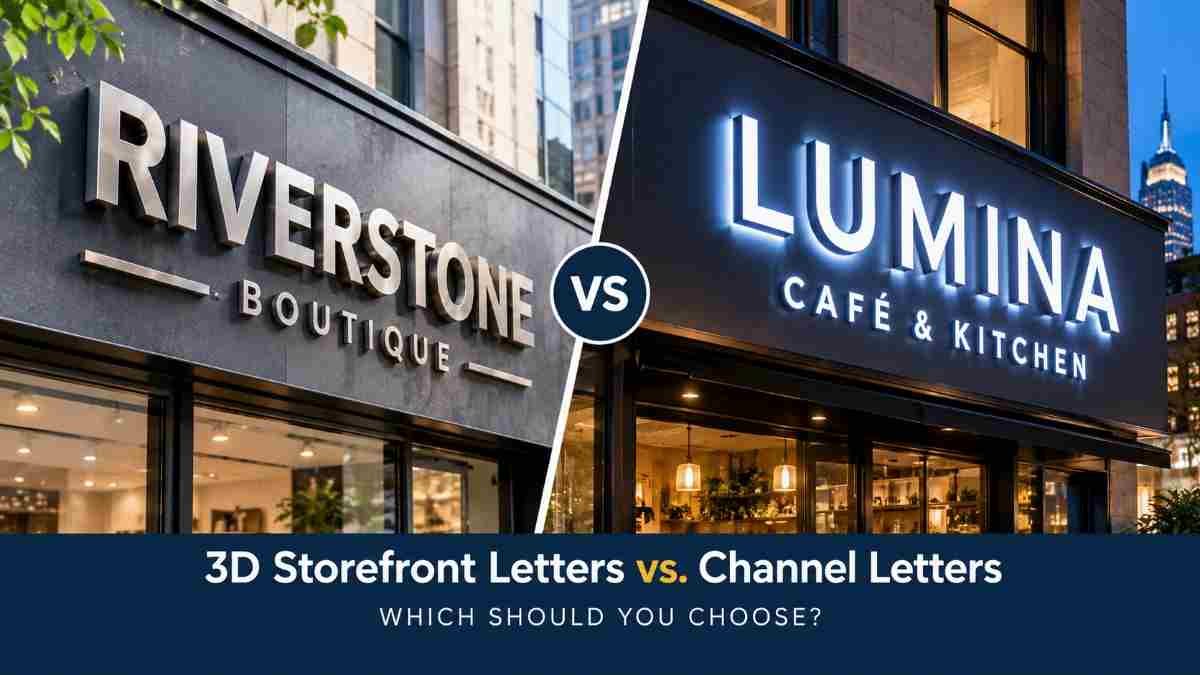

Your storefront sign is often the first thing potential customers notice when they approach your business. In New York City, where retail stores, restaurants, offices, and commercial properties compete for attention, choosing the right signage can make a meaningful difference to your visibility and brand presentation.
Two popular options are 3D storefront letters and channel letters. Both display your business name using dimensional lettering, but they differ in construction, lighting, appearance, installation requirements, and cost.
Traditional 3D storefront letters are often non-illuminated and rely on their material, depth, and contrast to stand out. Channel letters are individually fabricated, typically with an internal cavity that can accommodate LED lighting, making them a popular choice for businesses that want their signage to remain visible after dark.
So, which option is better for your NYC storefront?
The answer depends on your location, operating hours, branding goals, budget, and building requirements. This guide compares both options to help you choose the right signage for your business.
What Are 3D Storefront Letters?
3D storefront letters, also called dimensional letters or dimensional lettering, are individual raised characters or logo elements mounted onto a building facade, sign panel, or storefront surface.
Unlike flat printed graphics, these letters have physical depth. Their raised construction creates natural shadows and highlights, giving the business name a more prominent appearance.
Common Materials for 3D Storefront Letters
- Acrylic: Offers a wide range of colors, thicknesses, and contemporary finishes.
- Aluminum: Provides a versatile, relatively lightweight option for many exterior applications.
- Stainless steel: Creates a refined metallic appearance and can offer good corrosion resistance when appropriately specified.
- Brass and specialty finishes: Suitable for selected premium or traditional branding styles.
- PVC and other dimensional materials: May be suitable for specific applications when the material is rated for the intended exposure.
The appropriate material depends on the desired appearance, outdoor exposure, mounting method, and maintenance requirements.
Are 3D Storefront Letters Illuminated?
Not necessarily. Standard dimensional letters are often non-illuminated, relying on ambient light and their raised profile for visibility.
However, dimensional lettering can also be designed with lighting. The exact construction depends on the material, letter design, and intended lighting effect.
For businesses seeking raised lettering with a premium, understated appearance, non-illuminated 3D letters can be an effective option.
Explore our custom 3D letters and logo signage to learn more about dimensional signage options.
What Are Channel Letters?
Channel letters are individually fabricated letters commonly used for illuminated commercial signage. They typically consist of a shaped face, side returns that create depth, and a backing or other structural components. Many designs incorporate LED lighting.
Because each character is fabricated separately, channel letters can create a prominent, dimensional sign that works well for retail storefronts and other commercial locations.
Common Types of Channel Letters
- Front-lit channel letters: These use a translucent face to direct light toward the viewer. They are often selected for storefronts that need strong nighttime visibility.
- Halo-lit channel letters: These direct light toward the mounting surface, creating a glow around the letters. They can provide a more subtle, premium effect.
- Combination-lit letters: Some designs combine front illumination with other lighting effects, depending on the construction.
- Non-illuminated channel-style letters: Fabricated dimensional letters can resemble channel letters without internal lighting, depending on the design and specification.
Channel letters may be mounted individually, installed on a raceway, or attached to a suitable sign panel. The appropriate system depends on the facade, sign layout, building requirements, and installation conditions.
For more information, explore our channel letter signage guide for NYC businesses.
3D Storefront Letters vs. Channel Letters: Key Differences
Although both options create dimensional signage, their typical applications and visual effects differ.
| Feature | 3D Storefront Letters | Channel Letters |
|---|---|---|
| Typical lighting | Often non-illuminated | Frequently LED-illuminated |
| Appearance | Raised, material-focused lettering | Dimensional lettering with lighting options |
| Nighttime visibility | Depends on ambient or external lighting | Often stronger with suitable illumination |
| Materials | Acrylic, metal, PVC, and other suitable materials | Commonly fabricated metal returns with acrylic or other suitable faces |
| Finish options | Wide range of colors and metallic finishes | Multiple face, return, and lighting combinations |
| Mounting | Individual mounting, studs, or panels | Individual mounting, raceways, or suitable panels |
| Installation complexity | Depends on size, substrate, and design | May include electrical and lighting requirements |
| Maintenance | Material, finish, and mounting dependent | May also require lighting and electrical maintenance |
| Typical budget factors | Material, depth, finish, size, and installation | Fabrication, lighting, electrical work, mounting, and installation |
| Best suited for | Branding-focused storefronts and architectural lettering | Businesses seeking illuminated storefront visibility |
The main distinction is that 3D lettering describes the dimensional form, while channel letters describe a particular fabricated sign construction. The categories can overlap: channel letters are themselves dimensional, and some dimensional letters can be illuminated.
1. Visibility: Which Sign Gets More Attention?
Visibility is one of the biggest considerations for NYC storefronts. A sign may need to be seen by pedestrians, people approaching from across the street, or customers arriving after sunset.
Visibility of 3D Storefront Letters
Non-illuminated 3D letters create depth through their raised profile. Their effectiveness depends on the letter size, color contrast, material finish, mounting height, viewing distance, and available light. Metal letters can reflect daylight, while colored acrylic letters can provide strong contrast against the building facade.
These signs can be particularly effective for storefronts in well-lit areas or businesses that primarily operate during daylight hours. However, non-illuminated lettering may become less noticeable after dark if the storefront has insufficient lighting.
Visibility of Channel Letters
Illuminated channel letters can improve visibility during evening hours and in locations where ambient light is limited. Front-lit designs make the letter faces visible, while halo-lit designs create a glow against the wall. The effect depends on the lighting system, letter dimensions, background, and surrounding light levels.
Channel letters can be particularly useful for restaurants, retail stores, and businesses that operate after sunset.
Which Is Better for NYC Storefronts?
Choose non-illuminated 3D letters when the goal is to create a refined dimensional appearance and the location provides adequate visibility. Consider illuminated channel letters when the business needs stronger visibility after dark or wants its name to stand out in a busy commercial area.
Neither design guarantees more foot traffic on its own. Storefront placement, sign readability, surrounding competition, and the overall customer experience also matter.
2. Appearance and Branding
Your sign should reflect your brand identity and complement the architecture of your storefront.
The Look of 3D Storefront Letters
Dimensional letters can create a clean, architectural appearance. Brushed stainless steel, aluminum, brass finishes, and custom-colored acrylic can all produce different visual effects. They work well when material quality, letter depth, and a carefully coordinated finish are important to the design.
For example, a professional office may use brushed metal lettering on a stone facade, while a boutique could choose colored acrylic letters that match its brand identity.
The Look of Channel Letters
Channel letters provide more opportunities to incorporate illumination into the sign design. Front-lit letters can make brand colors visible after dark, while halo-lit letters create a softer glow around the characters. Different face and return finishes can also affect the overall appearance.
These options can suit businesses that want their storefront signage to remain visually prominent throughout the day and evening.
Which Creates a More Premium Look?
Neither option is automatically more premium. A well-designed non-illuminated metal sign can look sophisticated, while carefully fabricated channel letters can provide a polished and professional appearance.
The best choice depends on your brand, the building facade, the sign proportions, and the lighting effect you want.
3. Materials and Durability
NYC exterior signs must be designed for their actual installation environment. Rain, temperature changes, sunlight, pollution, and wind exposure can all affect performance.
Materials for 3D Storefront Letters
Acrylic, aluminum, stainless steel, and other suitable dimensional materials can work for exterior applications when properly specified.
Important considerations include:
- Material grade and thickness
- Finish and coating quality
- UV and weather exposure
- Mounting hardware and substrate
- Water management around joints and fixing points
- Expected maintenance requirements
For example, aluminum can provide a lightweight solution, while appropriately specified stainless steel can suit projects that require a metallic finish.
Materials for Channel Letters
Channel letters often use fabricated metal returns, with faces and other components selected for the intended lighting and appearance. The complete assembly must be suitable for outdoor use, including its electrical components, wiring, seals, mounting hardware, and finishes.
A high-quality lighting system does not eliminate the need for proper fabrication and weather protection.
Which Lasts Longer?
There is no universal lifespan advantage for either option. Longevity depends on the materials, manufacturing quality, installation, environmental exposure, and maintenance. Non-illuminated letters have no internal lighting components to service, while channel letters may require occasional inspection or repair of their lighting systems.
Both types should be designed and installed for the conditions at the specific property.
4. Mounting and Installation
It affects the sign’s appearance, stability, installation time, and long-term performance.
Mounting 3D Storefront Letters
Dimensional letters may be attached individually using suitable mounting hardware, studs, or a supporting panel. Individual mounting can create a clean look because the characters appear to sit directly on the building facade. Spacers may be used to create additional depth and shadows.
The correct method depends on the wall material, letter size and weight, building condition, and exposure.
Mounting Channel Letters
Channel letters can be mounted individually, installed on a raceway, or attached to a suitable sign panel. A raceway can group the electrical connections and provide a common mounting structure, depending on the sign design and building requirements. Individual mounting can create a cleaner appearance but may involve more site-specific installation work.
Illuminated signs also require appropriate electrical connections and access for future maintenance.
What Should NYC Businesses Consider?
Before installation, confirm:
- The facade material and condition
- The sign dimensions and weight
- The mounting hardware and attachment points
- Electrical access for illuminated signs
- Landlord and building requirements
- Applicable permits and approvals
- Safe access for installation and maintenance
The sign design should be finalized only after the installation conditions have been reviewed.
5. Budget: Are 3D Letters Cheaper Than Channel Letters?
The total cost depends on the complete project specification. Non-illuminated dimensional letters can be more economical for straightforward designs, but a complex metal sign may cost more than a simple illuminated sign in some circumstances.
Cost Factors for 3D Storefront Letters
The price may depend on:
- Material and material grade
- Letter height, depth, and thickness
- Number of letters and complexity of the logo
- Finish, paint, or specialty coating
- Mounting hardware and supporting panels
- Installation access and labor
A simple set of acrylic letters may require less fabrication than a large, individually fabricated metal logo.
Cost Factors for Channel Letters
Channel-letter pricing can include additional components and labor, such as:
- Fabricated letter faces and returns
- LED modules and electrical components
- Wiring and power supplies
- Raceway or other mounting systems
- Lighting design and testing
- Installation access and electrical work
- Maintenance access and future servicing
The cost varies with letter dimensions, lighting style, quantity, mounting method, and site conditions.
Which Offers Better Value?
Compare the complete project cost rather than only the initial fabrication price. If the business does not need nighttime illumination, non-illuminated dimensional letters may provide the appearance it wants without additional lighting components.
If nighttime visibility is important, illuminated channel letters may justify the additional investment. For further cost information, read our guide to how much channel letters cost in NYC.
6. Maintenance Requirements
Maintenance is another important difference between non-illuminated dimensional lettering and illuminated channel letters.
Maintaining 3D Storefront Letters
Routine care generally involves checking the sign’s finish, mounting points, and overall condition. Cleaning should follow the material manufacturer’s recommendations. Abrasive pads and unsuitable chemicals may scratch acrylic or damage certain metal finishes and coatings.
For elevated installations, inspections should be conducted by qualified personnel using appropriate access and safety procedures.
Maintaining Channel Letters
Channel letters require the same general attention to exterior materials and mounting, along with additional checks for lighting and electrical components.
Potential maintenance tasks include:
- Checking for uneven or failed illumination
- Inspecting wiring enclosures and connections
- Looking for signs of water intrusion
- Cleaning the letter faces and exterior surfaces
- Checking mounting hardware and supporting structures
Electrical repairs should be handled by qualified professionals.
Which Requires Less Maintenance?
Non-illuminated letters generally have fewer components that can fail because they do not require an internal lighting system. However, material and installation quality remain important.
Channel letters involve additional lighting components that may need servicing over time. The actual maintenance requirements depend on the design, components, exposure, and operating conditions.
7. Which Sign Is Best for Different NYC Businesses?
The best sign depends on the business’s location, operating hours, facade, and brand requirements.
| Business type | Option to consider | Why |
|---|---|---|
| Boutique retail store | 3D letters or channel letters | Depends on brand style and nighttime visibility |
| Restaurant or café | Illuminated channel letters | Useful when evening visibility is important |
| Corporate office | Non-illuminated metal letters | Can create a refined architectural appearance |
| Professional practice | Dimensional metal or acrylic letters | Offers flexible branding and finish choices |
| Convenience store | Illuminated channel letters | Can improve visibility during extended hours |
| Luxury retail | Metal dimensional letters or halo-lit letters | Supports a refined storefront presentation |
| Daytime-only business | Non-illuminated 3D letters | May provide sufficient visibility without lighting |
| High-traffic commercial storefront | Either option | Depends on viewing distance, ambient light, and building design |
These are starting points, not fixed rules. A site assessment can help determine which option fits the storefront.
For additional exterior signage options, explore our storefront retail signs in NYC page.
8. Can You Combine 3D Storefront Letters and Channel Letters?
Yes. A storefront design can incorporate different types of dimensional lettering when the combination supports the brand and building. For example, a business could use non-illuminated metal letters for its primary logo and illuminated channel letters for a separate business name or entrance sign.
A coordinated design can create visual hierarchy while using illumination where it provides the most benefit. However, combining sign types requires careful planning. Materials, letter heights, colors, spacing, mounting methods, and lighting effects should work together rather than compete for attention. Check the property’s sign requirements before deciding on the final combination.
9. What About Permits for Storefront Signs in NYC?
NYC storefront signage may be subject to building, zoning, electrical, landmark, and other requirements depending on the property’s location and the proposed sign. Requirements can vary based on sign size, projection, illumination, mounting, building type, and whether the property is within a designated historic district.
Before fabrication or installation, confirm:
- Whether the landlord or property manager requires approval
- Whether permits or filings are necessary
- Whether additional requirements apply to illuminated signage
- Whether the sign projects over a sidewalk or public space
- Whether the building has landmark or historic restrictions
- Whether the proposed mounting system is suitable for the facade
Do not assume that all storefront signs follow the same rules. Verify current requirements for the specific location and sign design.
10. How to Choose the Right Storefront Sign
Use the following checklist to guide your decision.
- Define your operating hours. If your business needs to be visible after dark, illuminated signage may be worth considering.
- Review your storefront location. Evaluate ambient light, viewing distance, surrounding buildings, and competing signs.
- Match the sign to your brand. Choose materials and finishes that complement your identity and the architecture.
- Compare complete quotes. Include fabrication, lighting, mounting, installation, and expected maintenance.
- Evaluate the facade. Confirm the mounting method and any structural considerations.
- Check building and regulatory requirements. Obtain necessary approvals before fabrication or installation.
- Review a final design proof. Confirm the dimensions, letter spacing, materials, finish, lighting, and placement.
Taking these steps can help you select a sign that balances appearance, performance, and cost.
Conclusion: Which Should You Choose?
When comparing 3D storefront letters vs. channel letters, start with your business’s visibility requirements, branding goals, and installation conditions.
- Choose non-illuminated 3D storefront letters if you want dimensional branding, a material-focused appearance, and a sign that works well with available lighting.
- Choose illuminated channel letters if you want your business name to remain prominent after dark and need a sign designed around internal lighting.
Both options can be effective for NYC storefronts when the materials, dimensions, mounting system, and finish are selected for the specific building. Planning a storefront sign for your NYC business? Explore our 3D letters and logo signage and storefront retail signage services, or request a custom signage quote to discuss your project.
Frequently Asked Questions
Are 3D storefront letters the same as channel letters?
Not exactly. 3D storefront letters describe raised lettering, which may or may not be illuminated. Channel letters are a specific type of fabricated dimensional lettering commonly designed with internal LED illumination.
Are channel letters better than non-illuminated 3D letters?
Channel letters may be better when nighttime visibility is important. Non-illuminated 3D letters can be suitable when the business prioritizes material appearance and has sufficient ambient lighting. The right choice depends on the location and business requirements.
Which is cheaper: 3D letters or channel letters?
Straightforward non-illuminated letters may cost less because they do not require lighting components. However, material, size, fabrication, mounting, and installation can change the comparison.
Can 3D storefront letters be used outdoors in NYC?
Yes, provided the material, finish, mounting hardware, and fabrication are appropriate for outdoor exposure. Weather, sunlight, wind, and the condition of the building facade should be considered.
Do channel letters use LED lighting?
Many modern channel letters use LED modules, but the exact construction depends on the sign design. Ask the sign provider to specify the lighting system and its maintenance requirements.
Can channel letters be installed without a raceway?
Yes. Some channel letters can be mounted individually, depending on the design and building conditions. The choice affects appearance, wiring, mounting, and installation requirements.
How long do storefront letters last?
There is no universal lifespan for all dimensional letters. Durability depends on materials, fabrication quality, installation, exposure, and maintenance. Illuminated signs also have lighting components that may require service.
Do I need a permit for storefront letters in NYC?
Some installations require permits or other approvals, depending on the sign, property, mounting, illumination, and applicable rules. Confirm requirements for your exact location before installation.