
Office nameplates may be small, but they play an important role in creating an organized and professional workplace. They help employees, clients, visitors, and business partners identify individual offices, conference rooms, departments, and workstations.
For corporate offices in New York City, custom office nameplates can also contribute to the overall appearance of the workspace. A carefully designed nameplate can complement reception signage, interior branding, and the architectural style of the office.
From engraved metal nameplates outside executive offices to modern acrylic signs on glass partitions, businesses have several options for creating professional workplace identification.
The right choice depends on the installation location, material, finish, lettering style, and information that needs to be displayed.
In this guide, we explore custom office nameplates, popular materials, design ideas, and practical considerations to help NYC businesses select the right signage for their workspaces.
1. What Are Custom Office Nameplates?
Custom office nameplates are personalized signs used to identify individuals, offices, departments, meeting rooms, and other workplace areas. Unlike generic printed labels, custom nameplates are manufactured to match a business’s branding, interior design, and identification requirements.
They can display:
- Employee or executive names
- Professional titles and designations
- Department names
- Conference room names
- Office numbers
- Company logos
- Suite and room identification
Office nameplates are commonly installed on doors, walls, glass partitions, cubicles, reception areas, and desks. Depending on the application, they can be manufactured using metal, acrylic, engraved laminates, or combinations of different materials.
2. Types of Office Nameplates for Professional Workspaces
Different areas of an office require different types of identification. Selecting the appropriate format helps maintain consistency while making the workspace easier to navigate.
Executive office nameplates
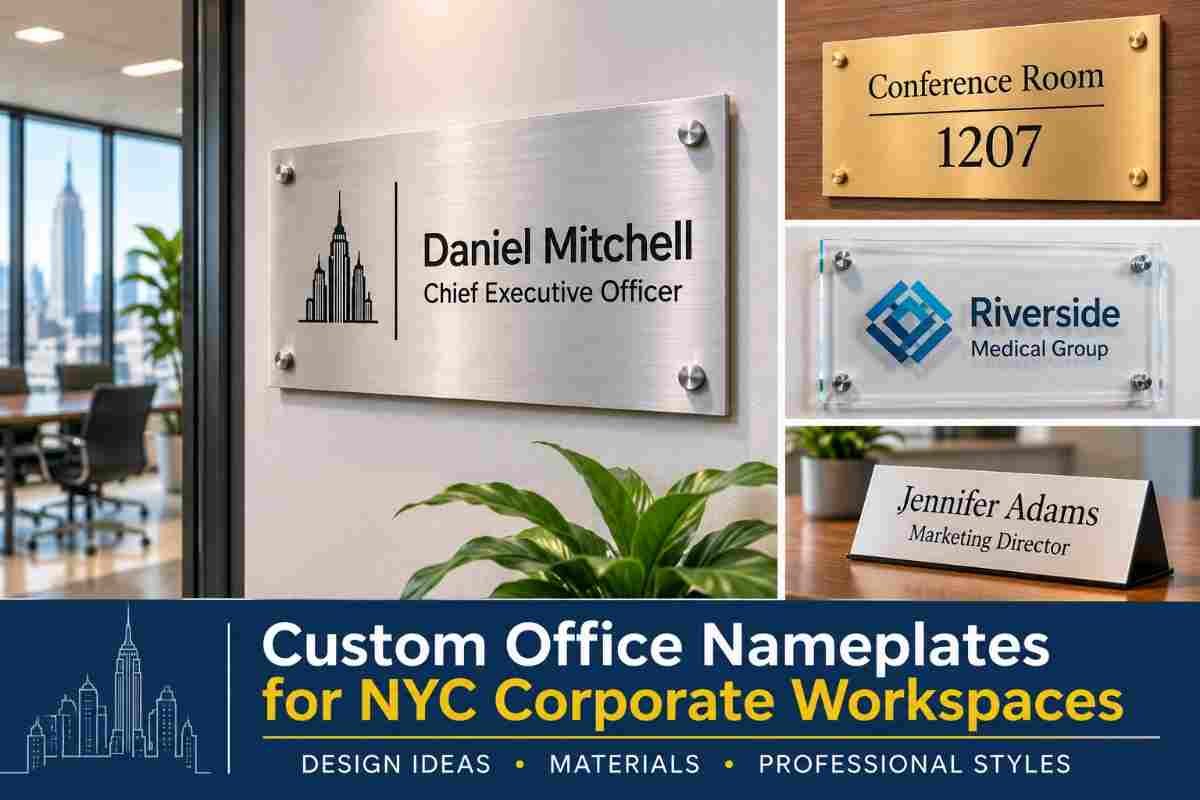
Executive nameplates identify senior management, directors, partners, and department heads. They are commonly installed beside or on office doors and may include the person’s name, professional title, and company branding. Popular options include brushed stainless steel, brass-finish plaques, and premium acrylic nameplates.
Office door nameplates
Door nameplates help visitors identify individual offices without needing to ask for directions. They can display employee names, job titles, department names, or room numbers. These signs are particularly useful in law firms, corporate offices, medical practices, and professional buildings.
Desk nameplates
Desk nameplates identify employees at their workstations or reception desks. They are generally smaller than wall-mounted office plaques and may include a person’s name, title, or department. Acrylic, metal, and engraved laminate are common options depending on the desired appearance.
Conference room nameplates
Conference room signs identify meeting spaces and help employees and visitors find the correct room. Businesses may use simple room names such as Boardroom, Conference Room A, or Executive Meeting Room. For a consistent workplace appearance, conference room nameplates can follow the same material and finish as office door signage.
Department identification nameplates
Larger offices may require identification for departments such as Human Resources, Finance, Marketing, Operations, and Administration. Consistent department signage helps visitors navigate the workplace and creates a more organized environment.
3. Best Materials for Custom Office Nameplates
The material has a significant effect on the appearance, durability, and customization possibilities of an office nameplate.
Stainless steel nameplates
Stainless steel offers a clean and professional appearance that works well in modern corporate interiors. It is available in brushed, satin, and polished finishes and can be customized with engraved or raised lettering.
Best suited for:
- Executive offices
- Corporate departments
- Professional office doors
- Modern commercial interiors
Brass nameplates
Brass provides a traditional and premium appearance. It is often selected by businesses that want a more formal style. Brass-finish nameplates can work particularly well in law firms, financial offices, private practices, and established professional organizations.
Best suited for:
- Law firm offices
- Executive suites
- Private offices
- Traditional corporate interiors
Aluminum nameplates
Aluminum is lightweight and versatile. It can be fabricated in different shapes and finishes, making it suitable for a variety of workplace identification requirements.
Best suited for:
- Department identification
- Office door signs
- Building directories
- General corporate identification
Acrylic nameplates
Acrylic is a popular option for contemporary workplaces. It is available in clear, frosted, colored, and opaque finishes. Acrylic nameplates can be printed, engraved, or layered to create different visual effects.
Best suited for:
- Modern office doors
- Reception desks
- Glass partitions
- Conference rooms
- Creative and technology workplaces
Engraved laminate nameplates
Engraved laminate is commonly used for practical identification signs. It can display names, titles, room numbers, and other information in a clear, easy-to-read format.
Best suited for:
- Employee identification
- Room numbers
- Department labels
- High-volume office signage
Material comparison
| Material | Appearance | Common applications |
|---|---|---|
| Stainless steel | Modern and professional | Executive offices and corporate doors |
| Brass | Traditional and premium | Law firms and private offices |
| Aluminum | Versatile and lightweight | Departments and office identification |
| Acrylic | Contemporary and customizable | Reception areas and glass partitions |
| Engraved laminate | Practical and clear | Room numbers and employee identification |
The best material depends on the office environment, desired design, and how the nameplate will be used.
4. Office Nameplate Design Ideas for NYC Businesses
A good office nameplate should be easy to read, visually consistent, and appropriate for the surrounding interior.
Here are some design approaches businesses can consider.
Minimalist metal nameplates
A brushed stainless steel nameplate with simple lettering creates a clean and understated appearance. This style works well in corporate offices where the goal is to maintain a consistent and professional look.
Premium brass office nameplates
Brass-finish nameplates can complement traditional interiors, wood doors, and formal office environments. They are particularly suitable for executive offices, law firms, and established professional practices.
Clear acrylic nameplates
Clear acrylic nameplates can create a subtle floating effect, particularly when mounted using metal standoffs. They are suitable for modern offices with glass partitions, neutral walls, and contemporary furniture.
Frosted acrylic nameplates
Frosted acrylic provides a softer appearance than clear acrylic and can help create a consistent look across glass and office partitions.
Branded office nameplates
Businesses can incorporate their company logo, brand colors, and typography into their nameplates. The design should maintain a clear hierarchy so the employee’s name or room identification remains easy to read.
Consistent nameplate systems
For offices with many employees and departments, using a standardized design is often the most practical approach. The same material, dimensions, typography, and mounting style can be used throughout the workspace while allowing individual names and titles to change.
5. Engraved vs. Printed Office Nameplates
Engraving and printing are two common ways to customize office nameplates. The right method depends on the material, design, and expected appearance.
Engraved nameplates
Engraving creates lettering or graphics within the surface of a suitable material. It is commonly used for metal, acrylic, and engraving laminates.
Advantages include:
- A refined, professional appearance
- Precise lettering and details
- Suitable options for permanent identification
- Compatibility with several materials
- Options for color-filled lettering
Engraved nameplates are a good choice when a business wants a formal and durable identification solution.
Printed nameplates
Printing allows businesses to incorporate colors, logos, and detailed graphics. It is particularly useful when brand colors or more complex artwork need to be reproduced.
Advantages include:
- Flexible color options
- Detailed logo reproduction
- Suitable for branded office designs
- Options for graphics and custom layouts
The printing process and protective finish should be selected according to the material and expected use.
Which should you choose?
Engraving is often preferred for understated metal nameplates and formal identification. Printing may be more appropriate when the design requires multiple colors, detailed graphics, or specific brand elements.
Both methods can produce professional results when matched with the right material and design.
6. Office Nameplates for Different Business Types
Different professional environments have different identification requirements.
- Law firms: Law firms often require nameplates for partners, associates, conference rooms, private offices, and reception areas. Brushed metal and brass-finish nameplates can complement traditional professional interiors. A consistent design across individual offices can also help establish a polished and organized environment.
- Medical and dental practices: Medical practices may use nameplates for doctors, consultation rooms, departments, reception areas, and administrative offices. Acrylic and metal options can work well depending on the interior design. Nameplates should prioritize legibility and use clear, straightforward wording.
- Corporate offices: Large corporate workspaces often require a coordinated signage system for executives, employees, departments, meeting rooms, and shared facilities. Standardized dimensions and layouts help maintain consistency throughout the building.
- Financial and consulting firms: Financial and consulting offices may prefer understated materials and finishes that complement formal interiors. Brushed stainless steel, brass-finish plaques, and clear acrylic are options worth considering.
- Technology and creative companies: Technology companies and creative agencies may prefer contemporary acrylic designs, custom colors, and clean typography. The nameplate system can reflect the company’s visual identity without making individual signs difficult to read.
7. Office Nameplates for Glass Doors and Partitions
Modern NYC offices frequently use glass doors and partitions to create open, bright workspaces. These surfaces require thoughtful signage choices because the background can affect readability and mounting options.
- Clear acrylic signs: Clear acrylic can provide a subtle appearance on glass surfaces. Depending on the design, it can be mounted using standoffs or another suitable fixing system.
- Frosted acrylic signs: Frosted acrylic can create a softer visual contrast against glass and is useful for office names, room identification, and departmental signage.
- Vinyl lettering: Vinyl lettering can be applied directly to suitable glass surfaces to display names, titles, and room information. It can be useful when businesses want a minimal sign without a separate plaque.
- Mounting considerations: Before installing a nameplate on glass, consider the glass type, available mounting area, sign weight, and suitable fixing method. Avoid assuming that every mounting method is appropriate for every glass partition.
8. How to Choose the Right Size and Placement
Office nameplates need to be readable without overwhelming the surrounding space.
Before selecting dimensions, consider the following factors.
- Available space: The nameplate should fit the door, wall, partition, or desk without interfering with handles, hardware, or other signage.
- Viewing distance: Text size should be appropriate for the distance from which visitors and employees will read the sign. A nameplate installed beside an office door may require a different layout from a desk nameplate viewed from a shorter distance.
- Information requirements: A sign displaying only a person’s name may be relatively small. A nameplate containing a name, title, department, and company logo will need enough space to maintain clear typography and visual hierarchy.
- Consistent positioning: In offices with multiple rooms, nameplates should ideally be installed at consistent heights and positions. This creates a more organized appearance and makes identification easier.
9. Custom Office Nameplates and ADA Considerations
Some office identification signs may be subject to accessibility requirements, depending on their purpose, location, and applicable regulations. For projects in NYC, businesses should evaluate whether specific signs require tactile lettering, Braille, contrast, or other accessibility features.
Do not assume that every office nameplate has identical requirements. The rules can differ between general decorative identification, room identification, and permanent signs used to identify certain spaces.
Before fabrication, confirm the applicable requirements for the specific sign and building. For additional information, read our guide to ADA signage requirements.
10. What Affects the Cost of Custom Office Nameplates?
The price of a custom office nameplate depends on its dimensions, material, production method, design, and quantity.
Important cost factors include:
- Material: Stainless steel, brass, aluminum, acrylic, and engraved laminate have different costs.
- Dimensions: Larger nameplates generally require more material.
- Thickness: Material thickness can influence weight, fabrication, and overall appearance.
- Lettering method: Engraving, printing, and raised lettering have different production requirements.
- Design complexity: Custom shapes, logos, multiple colors, and layered elements can affect the price.
- Mounting: Standoffs, concealed hardware, and other fixing systems may add to the cost.
- Quantity: Projects involving several standardized nameplates may have different production economics from a single custom sign.
- Installation: Wall conditions, access, and installation requirements may influence the overall project cost.
For an accurate estimate, provide the number of nameplates, dimensions, wording, preferred material, and installation locations.
11. Common Mistakes to Avoid When Ordering Office Nameplates
A nameplate should be designed for everyday use, not just appearance.
Avoid these common mistakes:
- Using lettering that is too small: Names and titles should remain readable from the expected viewing distance.
- Choosing a finish with insufficient contrast: Text should stand out clearly against the background.
- Including too much information: Keep the layout focused on the most important identification details.
- Using inconsistent designs: Different styles across departments can make an office look disorganized.
- Ignoring the mounting surface: Door materials, glass partitions, and wall finishes may require different fixing methods.
- Using outdated employee information: Confirm spelling, titles, and department names before production.
- Overcomplicating the design: Too many fonts, colors, and decorative elements can reduce readability.
- Forgetting accessibility requirements: Check whether the specific sign needs accessibility features.
12. How to Order Custom Office Nameplates in NYC
A clear project brief helps ensure that the finished nameplates meet your workplace requirements.
Before requesting a quote, prepare the following information:
1. Number of nameplates: Confirm how many individual signs are required and whether they will follow a standard design.
2. Wording: Provide the exact names, titles, departments, and room information.
3. Material preference: Consider stainless steel, brass, aluminum, acrylic, or engraved laminate.
4. Dimensions: Share the approximate width and height or available installation space.
5. Artwork: Provide your company logo and any brand guidelines that should be followed.
6. Installation surface: Specify whether the signs will be mounted on doors, walls, glass partitions, or desks.
7. Reference images: Photographs of the workplace can help determine suitable materials, finishes, and mounting options.
Review the final artwork carefully before approving production, especially when multiple employee names or room labels are involved.
13. Custom Office Nameplates for NYC Corporate Workspaces
A coordinated office nameplate system can make a workplace easier to navigate while reinforcing its professional appearance. Whether you need engraved executive nameplates, acrylic conference room signs, or consistent identification across multiple departments, the design should reflect the workspace and remain easy to read.
CustomSignsNY provides custom signage for business interiors and professional environments. Explore our custom plaques for more information about plaque materials and customization options.
For larger workplace branding projects, take a look at our custom interior signage and 3D letters and logos services.
Final Thoughts
Custom office nameplates help create a professional, organized, and easy-to-navigate workplace. Whether you prefer engraved metal, traditional brass finishes, modern acrylic, or practical laminate signs, the right design should complement your office and communicate information clearly.
For NYC businesses, a coordinated approach to office identification can also strengthen the overall appearance of the workspace.
Planning custom office nameplates in NYC? Contact CustomSignsNY to discuss your requirements and explore suitable materials, finishes, and designs.
Frequently Asked Questions
1. What are office nameplates used for?
Office nameplates identify employees, executives, departments, conference rooms, and individual offices. They help visitors navigate professional workspaces and provide clear workplace identification.
2. Which material is best for office nameplates?
Stainless steel, brass, aluminum, acrylic, and engraved laminate are common options. The best material depends on the desired appearance, installation surface, budget, and customization requirements.
3. Can office nameplates include company logos?
Yes. Custom office nameplates can incorporate company logos, brand colors, employee names, titles, and other relevant information through engraving, printing, or dimensional elements.
4. Are acrylic nameplates suitable for glass office doors?
Yes. Acrylic nameplates can be used on suitable glass doors and partitions. Clear and frosted finishes are popular options, but the mounting method should be selected according to the glass and sign specifications.
5. Can office nameplates be engraved?
Yes. Metal, acrylic, and suitable engraving laminates can be customized using engraving methods. The appropriate process depends on the material and desired finish.
6. What should be included on an executive office nameplate?
An executive office nameplate may include the person’s name, professional title, and company logo. Keep the layout simple and ensure that the most important information is easy to read.
7. Can multiple office nameplates follow the same design?
Yes. Businesses can create a standardized nameplate system with consistent dimensions, materials, typography, and finishes while changing the individual names and titles.
8. Are office nameplates required to follow ADA guidelines?
Certain permanent room identification signs may need to meet applicable accessibility requirements. Requirements depend on the sign’s purpose and location, so the specific project should be reviewed before production.
9. How do I get a quote for custom office nameplates in NYC?
Provide the number of signs, exact wording, approximate dimensions, preferred material, logo, and installation details. These details help determine the appropriate design and production requirements.