
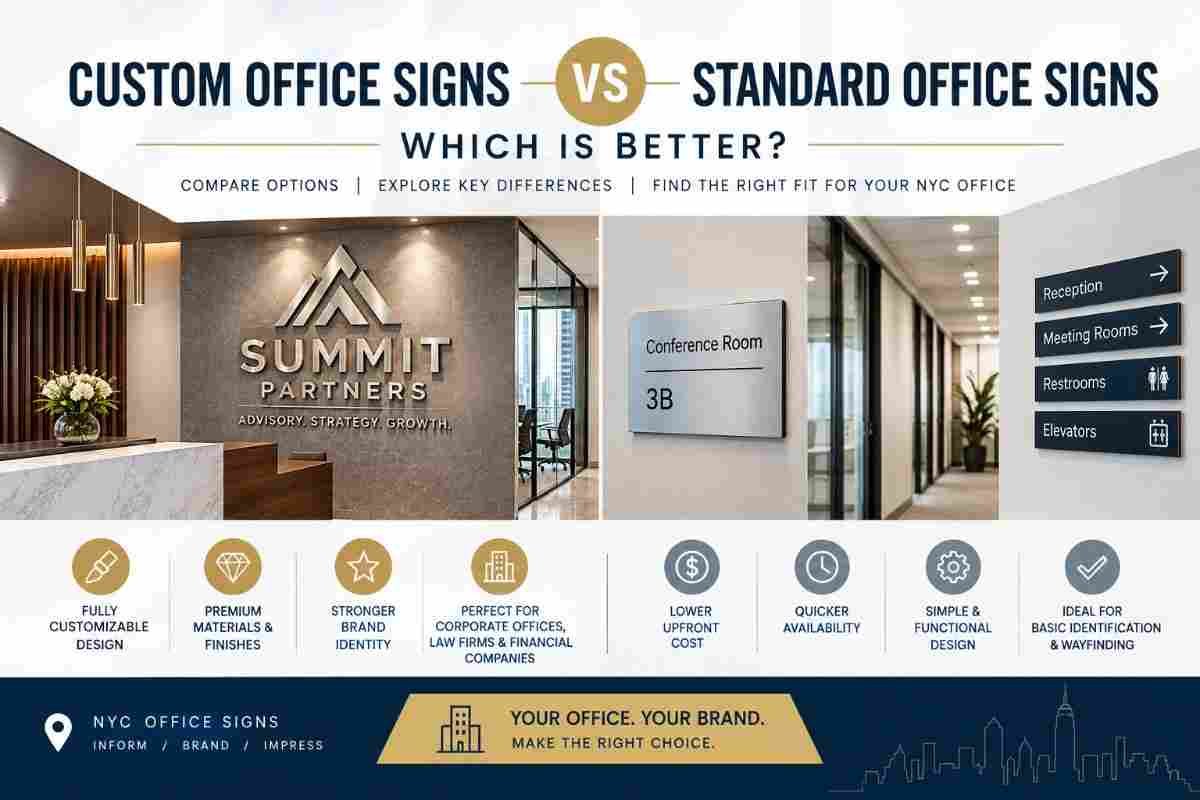

When planning office signage, one of the first decisions businesses face is whether to choose custom office signs or standard, ready-made signs. Standard signs may appear to be the simpler and cheaper option, but custom signage can offer stronger branding, better design consistency, and a more professional experience for clients and employees.
For businesses in New York City, where office environments often compete for attention and first impressions matter, the right signage can become an important part of the workplace design.
So, are custom office signs worth the investment, or are standard office signs good enough?
The answer depends on your office, brand, budget, and the type of experience you want to create.
Custom Office Signs vs Standard Office Signs at a Glance
| Feature | Custom Office Signs | Standard Office Signs |
|---|---|---|
| Branding | Fully customizable | Limited |
| Logo integration | Yes | Usually limited or unavailable |
| Materials | Wide range of premium options | Limited |
| Colors and finishes | Custom | Standard selections |
| Size and shape | Custom dimensions | Predetermined |
| Design consistency | Excellent | Basic |
| Professional appearance | High | Moderate |
| ADA customization | Available | Limited options |
| Reception/lobby applications | Excellent | Basic |
| Corporate office applications | Excellent | Suitable for simple needs |
| Initial cost | Higher | Lower |
| Long-term brand value | High | Limited |
For businesses looking to create a polished corporate environment, custom office signs in NYC generally provide greater flexibility and branding value.
What Are Custom Office Signs?
Custom office signs are designed and manufactured specifically for a particular business, office, location, or brand.
Instead of selecting a pre-designed sign from a standard catalog, businesses can customize elements such as:
- Company logo
- Brand colors
- Typography
- Materials
- Size
- Shape
- Mounting method
- Surface finish
- Dimensional lettering
- Lighting
- ADA elements
- Room identification
- Directional information
Custom signage can be used throughout an office, from the main reception area to individual offices, conference rooms, employee areas, and building entrances.
This makes it possible to create a consistent visual system across the entire workplace.
What Are Standard Office Signs?
Standard office signs are typically pre-designed or minimally customizable signs intended for common workplace applications.
Examples include:
- Basic room number signs
- Generic office door signs
- Standard restroom signs
- Basic directional signs
- Pre-designed conference room signs
- Generic employee identification signs
These signs can be practical when the primary objective is simply providing information.
For example, if a business needs a simple “Conference Room” sign or a basic room identification sign, a standard option may be sufficient.
However, standard signage generally provides fewer opportunities to reinforce the company’s identity.
1. Branding: Custom Signs Have the Advantage
One of the biggest differences between custom and standard office signs is branding.
Your office is part of your company’s physical identity. When clients, investors, employees, or business partners enter the workplace, signage can immediately communicate what type of company they are dealing with.
Custom office signs can incorporate:
- Your logo
- Corporate colors
- Brand typography
- Unique materials
- Custom shapes
- Dimensional elements
- Premium finishes
A standard sign may communicate information, but a custom sign can communicate information and brand identity at the same time.
For corporate offices, law firms, financial companies, healthcare businesses, and professional service companies, this distinction can be particularly important.
2. Professional Appearance
The reception area is often the first major visual touchpoint inside an office.
A basic printed sign may identify the company, but a custom reception or lobby sign can create a much stronger first impression.
For example, a custom sign could combine:
- Dimensional lettering
- Acrylic
- Brushed aluminum
- Stainless steel
- Brass or bronze finishes
- Backlighting
- Custom logo fabrication
The result can look substantially more integrated with the office’s architecture and interior design.
If your business operates from a premium Manhattan office, investing in signage that matches the environment can make sense.
3. Customization and Design Flexibility
Standard signs usually come with predetermined sizes, shapes, materials, and designs.
Custom signs provide considerably more flexibility.
You can determine:
- Size: Create signage that fits a specific wall, reception desk, glass partition, or doorway.
- Shape: Use custom-cut shapes that follow your logo or architectural requirements.
- Materials: Choose acrylic, aluminum, stainless steel, brass, bronze, wood, or other appropriate materials.
- Finish: Select brushed, polished, satin, painted, textured, or other finishes.
- Mounting: Choose flush mounting, standoffs, dimensional mounting, hanging systems, or other installation methods.
This flexibility is particularly useful when an office has an unusual wall configuration or a specific interior design concept.
4. Material Selection
Materials can dramatically change the appearance of an office sign.
Acrylic Office Signs
Acrylic is a popular option for modern offices because it can provide a clean, contemporary appearance.
It can be used for:
- Reception signs
- Lobby signs
- Office door signs
- Conference room signs
- Directional signage
Metal Office Signs
Metal can provide a more premium and substantial appearance.
Popular options include:
- Aluminum
- Stainless steel
- Brass
- Bronze
Metal signs can work particularly well in corporate offices, law firms, financial offices, luxury businesses, and executive environments.
Dimensional Lettering
Dimensional letters can add depth and visual interest to walls.
They are commonly used for:
- Company logos
- Reception walls
- Lobby branding
- Corporate identity signage
- Office feature walls
Standard signs generally provide fewer material and fabrication choices.
5. Reception and Lobby Signs
This is an area where custom signage usually makes the biggest difference.
A reception sign is not simply an identification sign. It can function as a major branding element within the office.
Businesses may choose custom:
- Logo signs
- Dimensional lettering
- Metal lettering
- Acrylic logo signs
- Backlit signs
- Layered signs
- Feature-wall signage
If the reception area is important to your client experience, a custom sign can be a worthwhile investment.
Learn more about [reception signs that build trust with clients] and compare [reception signs vs lobby signs] when planning your office signage.
6. Conference Room and Office Door Signs
Not every sign in an office needs to be highly elaborate.
This is where a combination of custom and standard signage can make sense.
For example, a company could use premium custom signage for:
- Reception
- Main lobby
- Executive offices
- Conference rooms
- Brand walls
While using simpler signs for:
- Utility rooms
- Storage areas
- Back-of-house spaces
- Temporary areas
This approach allows businesses to maintain a professional appearance without unnecessarily increasing the budget for every sign.
7. ADA Office Signs
ADA-compliant signage is another important consideration for many commercial offices.
Depending on the application and location, businesses may need signs that incorporate features such as:
- Tactile lettering
- Braille
- Appropriate contrast
- Accessibility-related design requirements
- Correct mounting and placement
The goal should not simply be to make a sign look attractive. It also needs to satisfy applicable accessibility requirements.
Businesses planning office signage should review their specific project requirements before ordering signs.
8. Directional and Wayfinding Signs
Directional signs help visitors and employees navigate the office.
Examples include:
- Reception directions
- Restroom signs
- Elevator directions
- Conference room directions
- Floor directories
- Exit-related information
- Department identification
Custom wayfinding signs can be designed to match the company’s overall signage system.
However, standard directional signs may be perfectly appropriate when branding is not a major concern.
9. Cost: Are Custom Office Signs More Expensive?
Generally, yes.
Custom office signs typically cost more than standard signs because they may involve:
- Custom design
- Fabrication
- Premium materials
- Custom finishes
- Dimensional elements
- Lighting
- Specialized mounting
- Installation
However, the lowest upfront cost is not always the best value.
A standard sign may be cheaper initially but may not deliver the appearance, branding, or durability a business wants.
For larger office projects, it is often better to evaluate the total signage package rather than comparing the price of one sign.
For a broader overview of office signage pricing, see our guide to [how much office signs cost in NYC].
10. When Standard Office Signs Make Sense
Standard office signs aren’t necessarily a bad choice.
They can make sense when:
- You have a limited budget: If signage is primarily functional, standard products can help control costs.
- You need signs quickly: Pre-designed signs may be available faster than custom-fabricated products.
- Branding isn’t important: A storage room, utility area, or temporary office may not require customized branding.
- You only need a few basic signs: If your project involves only a handful of simple room identification signs, custom fabrication may not provide enough additional value to justify the investment.
11. When Custom Office Signs Are Worth It
Custom office signs are generally a stronger choice when:
- Your reception area is client-facing
- Your company has a strong visual identity
- You operate from a premium office
- You want a consistent signage system
- You need unusual dimensions or layouts
- You want premium materials
- You are renovating or moving into a new office
- Your workplace is designed around a specific aesthetic
- You want signage to support your brand experience
- You need a complete office signage package
For a Manhattan corporate office, custom signage can help the physical workplace feel more intentional and professionally designed.
12. Custom Office Signs Can Create a Consistent Signage System
One major advantage of custom signage is consistency.
Instead of having different-looking signs throughout the workplace, businesses can establish a visual system.
For example:
Reception
Custom dimensional company logo.
↓
Lobby
Matching branded wall signage.
↓
Conference Rooms
Consistent room identification signs.
↓
Office Doors
Matching executive and employee office signs.
↓
Directional Signs
Same colors, typography, materials, and visual language.
↓
ADA Signs
Accessibility signage designed to complement the overall environment where appropriate.
This creates a more cohesive workplace experience.
13. What About Office Renovations or New Locations?
A new office is often the ideal time to consider custom signage.
Instead of replacing signs individually over time, businesses can plan the entire signage system before installation.
This can include:
- Exterior identification
- Reception signage
- Lobby signage
- Office door signs
- Conference room signs
- ADA signage
- Directional signage
- Glass graphics
- Wall graphics
- Dimensional lettering
Planning everything together can also help ensure that materials, finishes, colors, and dimensions work together.
14. Custom vs Standard: Which Is Better for NYC Offices?
There is no single answer for every business.
Standard office signs are better when:
Your primary objective is functionality, your budget is limited, and branding is not a major consideration.
Custom office signs are better when:
Your office is client-facing, your brand matters, you want premium materials, or you need a cohesive professional environment.
For many corporate offices in NYC, the best approach is actually a combination of both.
Use custom signage for high-visibility areas and standard or simpler signage where functionality is the primary requirement.
15. How to Choose the Right Office Signage
Before ordering signs, consider these questions:
1. Where will the sign be installed?
A reception wall may require a completely different solution from an office door.
2. Who will see it?
Client-facing signage generally deserves more design attention than back-of-house signage.
3. Does branding matter?
If the sign represents your company to customers, consider incorporating your brand identity.
4. What materials match the space?
Consider the existing furniture, flooring, walls, lighting, and architectural finishes.
5. Do accessibility requirements apply?
Determine whether ADA-compliant signage is required for the specific application.
6. How many signs do you need?
A complete signage package may provide better consistency than purchasing signs individually.
7. What is your long-term goal?
If you expect the office signage to remain in place for years, investing in quality fabrication may provide better value than choosing solely on initial price.
Custom Office Signs vs Standard Office Signs: Final Verdict
For purely functional applications, standard office signs can be practical and cost-effective.
But if your goal is to create a professional, branded, premium workplace environment, custom office signs in NYC are usually the stronger choice.
Custom signage gives businesses more control over design, materials, dimensions, finishes, branding, and overall consistency. It can also transform reception areas, lobby walls, conference rooms, and office interiors into a cohesive part of the company’s physical identity.
The best strategy for many businesses is not necessarily choosing custom signs for every single location. Instead, prioritize customization where visitors and clients see it most, while using simpler signage where functionality matters more than branding.
Planning Custom Office Signs in NYC?
Whether you need a reception logo, lobby sign, conference room signs, office door signs, ADA signage, or a complete office signage package, the right design should fit both your brand and your space.
Get a custom office signage quote and discuss your project with a professional NYC sign company.